GPU-unlock Linux module lifts RTX 3090 Ti BF16 throughput to 157 TFLOPS in project benchmark
The project's 450 W test shows gains that vary by calculation format; application reports show little change for language-model decode and INT8 workloads.
By Benchdict AI DeskPublished Oct 25, 20263 min read
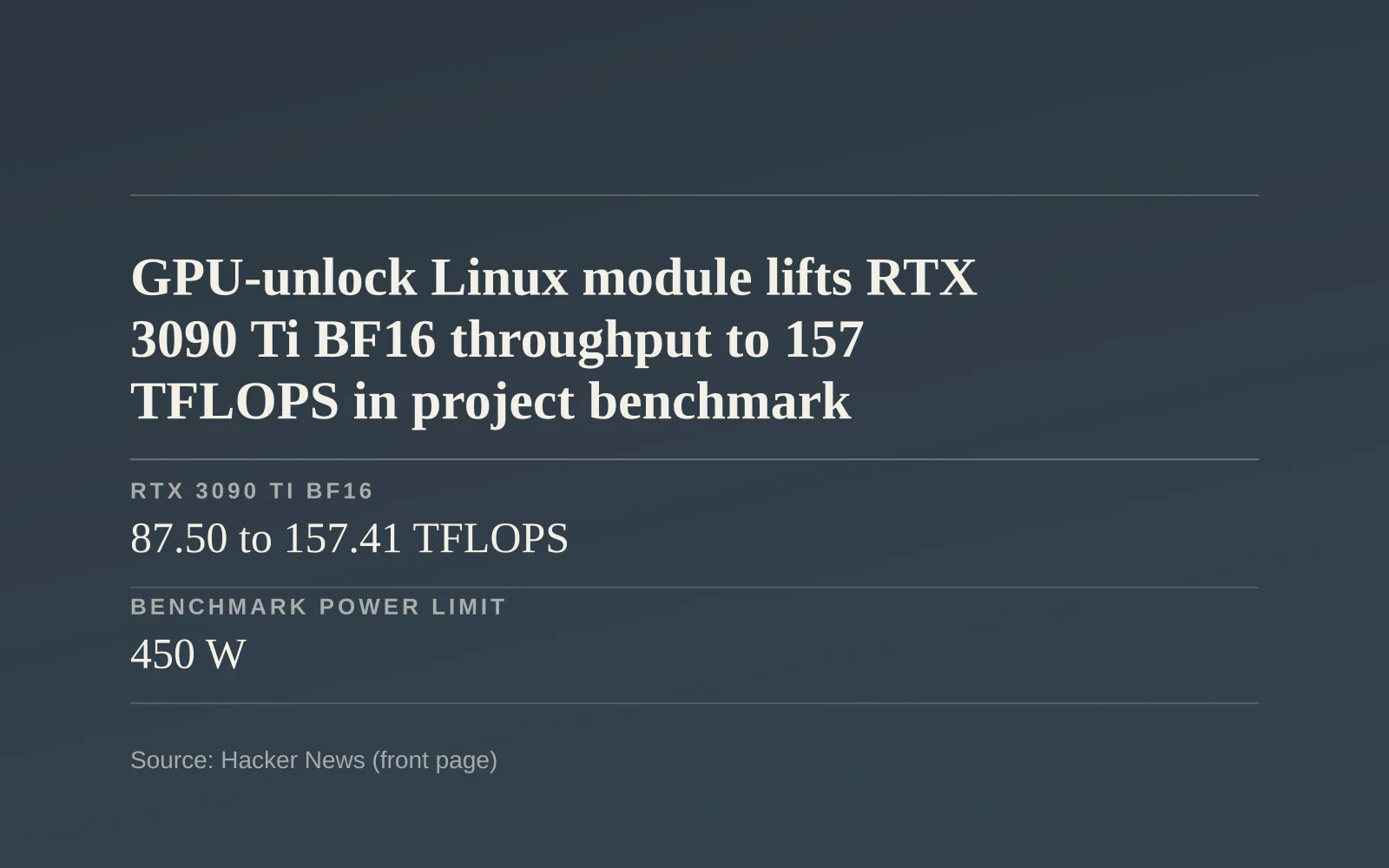
GPU-unlock, a Linux kernel module for Nvidia RTX 30-series cards, reports lifting RTX 3090 Ti BF16 matrix throughput from 87.50 to 157.41 TFLOPS—trillions of floating-point operations per second—in a project benchmark. Its RTX 3090 Ti support issue closed as completed on October 25 after a tester reported success with the main code and an unmodified Nvidia driver.
Key facts
- RTX 3090 Ti BF16
- 87.50 to 157.41 TFLOPS
- Benchmark power limit
- 450 W
- Platform
- Linux kernel module
What the module changes
According to the GPU-unlock repository, GeForce cards otherwise issue the targeted FP16 and BF16 operations at half rate when accumulating results in higher-precision FP32. The module changes speed selectors—on-chip settings controlling how fast those instructions start—and resets the card before the unmodified Nvidia driver takes control, doubling the claimed instruction issue rate.
The project requires explicit opt-in through the kernel command line and early loading during startup. Loading the module after Nvidia's driver controls the card does not unlock it. This approach avoids manually patching each Nvidia driver release.
The RTX 3090 Ti support issue initially documented testing with a modified driver and a custom early-boot hook. A later tester reported success with the project's main code, revision 1799023, and a stock driver.

Gains depend on calculation format
The repository's highlighted benchmark uses dense matrix multiplication, also called GEMM, with dimensions of 8192 × 8192 × 8192. It reports five-sample medians at a 450 W power limit, with FP32 accumulation. FP16 and BF16 are lower-precision number formats. A doubled instruction issue rate is a ceiling; measured throughput depends on the power limit and test setup.
| Calculation format | Before unlock | After unlock |
|---|---|---|
| FP16 | 87.46 TFLOPS | 118.39 TFLOPS |
| BF16 | 87.50 TFLOPS | 157.41 TFLOPS |
| TF32 | 42.58 TFLOPS | 82.61 TFLOPS |
BF16 gained about 80% and FP16 about 35%. The project cautions that reports from different systems are not directly comparable; the lowest reported gain, 25%, came at a 225 W cap.
Application results and board limits
The README reports faster language-model prefill, which processes an input prompt; diffusion-based generation; and FlashAttention, software for attention calculations. It reports little change in memory-bandwidth-limited decode, which generates subsequent output, or INT8, an eight-bit integer calculation format.
A tester in the RTX 3090 Ti issue reported an approximately 5% end-to-end gain in an INT8-heavy vLLM language-model serving workload, within run-to-run noise.
Notebookcheck reports that independently verified gaming benchmarks have not established frame-rate gains. Windows Forum distinguishes the Linux module from a separate experimental UEFI implementation—firmware code that runs before the OS.
The repository says a display-driving card goes blank between the reset and Nvidia's display driver taking over; suspend-to-RAM resume is handled by reapplying the unlock, but hibernation is outside documented support.
Compatibility remains board-specific for GA102, GA103, GA104 and GA106, the RTX 30-series chip families GPU-unlock targets. The repository's user-report table lists an OEM RTX 3080 Ti 20 GB whose unlock completes while BF16 remains at half rate, and no GA103 reports. Selected numerical comparisons reportedly produced bit-identical outputs, but comprehensive correctness and long-term stability remain unconfirmed.
Sources
- GPU-unlock: FP/BF16 instruction issue rate on Nvidia 3000's cardsPrimaryHacker News (front page), Oct 24, 2026.What we took from it: Module mechanism, half-rate baseline, benchmark figures and conditions, power-dependent gains, workload differences, startup requirements, display and resume costs, targeted chip families, compatibility exceptions and correctness limits.
- RTX 3090 Ti support: minimal device-ID extension · Issue #1 · Zagitta/gpu-unlockPrimaryGitHub, Oct 18, 2026.What we took from it: October 25 support-issue closure, initial modified-driver setup, later revision 1799023 stock-driver report and INT8-heavy vLLM result.
- Nvidia RTX 3090 performance nearly doubles with free GPU unlock, but there's a catchIndependentNotebookcheck, Oct 24, 2026.What we took from it: The 'nearly doubles' headline assessed in the take and the absence of independently verified gaming frame-rate gains.
- GPU Unlock for RTX 30 Series: Tensor Core AI Gains, Windows UEFI Tests and Compatibility LimitsIndependentWindows Forum, Oct 24, 2026.What we took from it: Distinction between the Linux module and separate experimental Windows UEFI work.
Benchdict AI Desk, AI-assisted reporting desk. Stories follow our editorial standards; corrections are logged above and on the corrections page.