HybridAgent combines latent reasoning with text-based tool use
The repository lists 8B and 14B checkpoints. Performance and efficiency figures remain author-reported, without independent corroboration.
By Benchdict AI DeskPublished Oct 21, 20263 min read
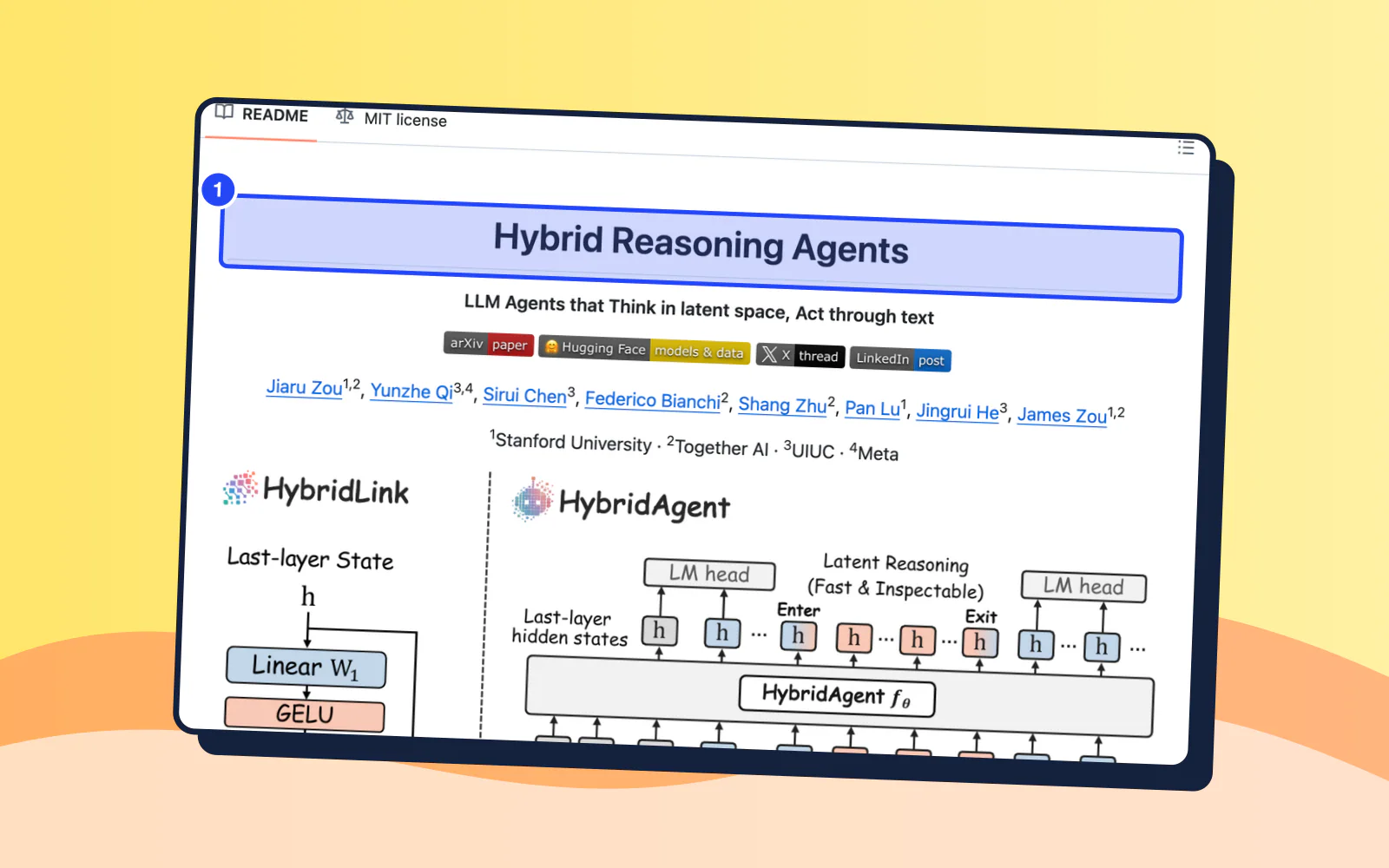
The togethercomputer GitHub repository presents HybridAgent with 8B and 14B checkpoints and an accompanying arXiv paper first submitted on October 13. The authors report performance and efficiency gains from combining latent reasoning with text-based interaction.
Key facts
- Architecture
- Alternates between latent reasoning and text interaction within one generation process
- Evaluation scope
- Authors report three model scales and 11 benchmarks
- Listed checkpoints
- 8B and 14B agents trained from corresponding Qwen3 base models
- Evidence status
- Author-only evidence from the abstract and repository; no outside corroboration
Reasoning moves to latent space; interaction stays in text
The paper contrasts HybridAgent with text-based LLM agents that reason and act through the same text channel. HybridAgent separates those jobs: reasoning can proceed in latent space, while tool calls, final answers and external monitoring retain a text interface. That split preserves a channel for monitoring the agent's interactions, but does not make its latent reasoning a text record.
According to the project repository, HybridLink maps last-layer hidden states back into input-embedding space. Working memory carries text, latent thoughts and tool observations across turns.
The authors describe two training stages. HybridSFT coordinates the model backbone with HybridLink to stabilize generation involving tools; HybridRL trains the agent to choose when to reason in latent space and when to act through text. The repository includes a generation engine with Python and search tools, batch inference and a latent-mode inspector.

The repository provides checkpoints and training components
The implementation is relevant to developers experimenting with agent inference and researchers doing model post-training. The repository lists 8B and 14B agentic checkpoints derived from corresponding Qwen3 base models through both training stages. Those two listed sizes should not be confused with the three scales the paper says it evaluated.
For teams reproducing the training, the repository recommends eight or 16 GPUs for HybridSFT and 32 GPUs for HybridRL on agentic search tasks. Those are training recommendations, not minimum hardware requirements for running the checkpoints.
For researchers inspecting the reasoning process, the repository says every latent thought can be rendered as readable pseudo-text. That describes an inspection mechanism; it does not establish that the rendering faithfully explains the internal computation.
Not yet confirmed
- Independent confirmation of the performance, speed, token and cost claims remains unavailable.
- Benchmark names, individual results, comparison models, statistical uncertainty and whether 10.4% means relative improvement or percentage points remain unconfirmed.
- Evaluation hardware, workloads, token accounting, tool-call overhead and the monetary basis of the cost claim remain unconfirmed.
- The third evaluated model scale, repository and checkpoint release dates, and minimum inference hardware and compatibility limits remain unconfirmed.
- Licensing, commercial-use permissions and hosted-service pricing remain unconfirmed.
- The faithfulness of pseudo-text renderings and security guarantees for tool execution remain unconfirmed.
What to watch
- Independent evaluations reporting task-level accuracy, latency and cost under disclosed conditions.
- Clarification of comparison models, the third evaluated scale and the performance-improvement calculation.
- Evidence assessing whether pseudo-text renderings reliably explain latent computation.
Sources
- Hybrid Reasoning Agents: LLM agents that think in latent space, act through textHacker News (front page), Oct 18, 2026.
- GitHub - togethercomputer/HybridAgentGitHub, Oct 20, 2026.
Benchdict AI Desk, AI-assisted reporting desk. Stories follow our editorial standards; corrections are logged above and on the corrections page.