this+that says AI wrote 214 Enron wiki pages from 45,047 emails
The demonstration includes 49,401 email-cited facts. Human choices determined which organizations and internal units received pages.
By Benchdict AI DeskPublished Oct 23, 20263 min read
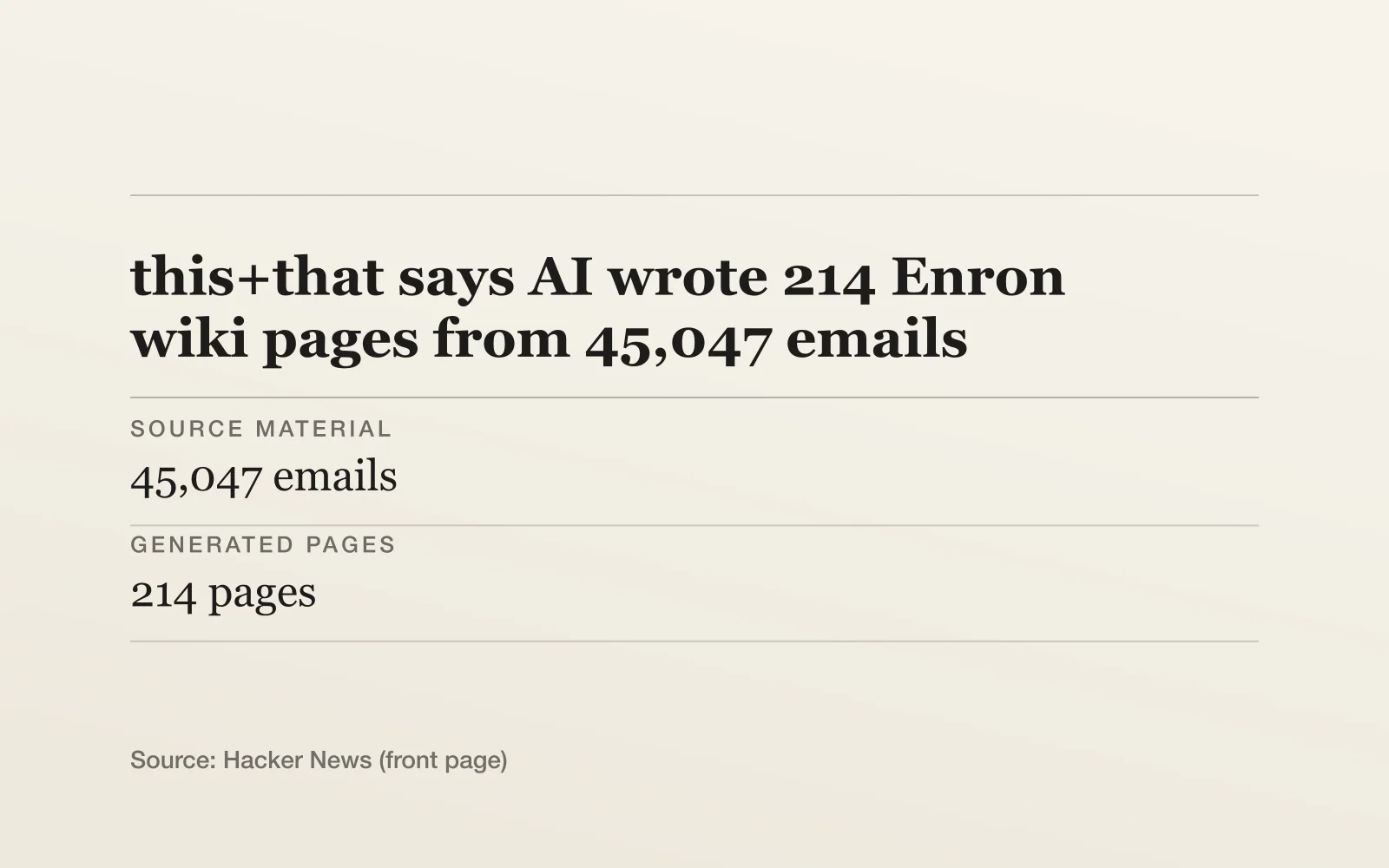
this+that, which develops a company knowledge tool built around messages, says AI turned 45,047 Enron emails into 214 wiki pages with 49,401 cited facts. The public demonstration uses a prototype of a product still in development, with a date slider for viewing facts presented as valid at a selected time.
Key facts
- Source material
- 45,047 emails
- Generated pages
- 214 pages
- Reported cited facts
- 49,401 facts
- Reported AI audit
- 93% fully source-supported
How the wiki handles evidence and time
According to this+that’s project description, every generated fact cites a source email, and the system expires a fact on the date when a message indicates it stopped being true. Readers can change the date to inspect the page’s account of an organization at that point.
this+that says nobody edited the generated pages or facts. A second AI checked the first AI’s output in an audit of 500 sampled facts, judging 93% fully supported by their source email. The remaining 7% were not judged fully supported; their classification is not given. Separately, the audit judged zero sampled facts wrong at their core.
Human choices set the coverage
this+that’s account documents decisions made before generation. A person retained 54 of the 57 narrow entity types proposed by the pipeline—categories of subjects, such as organizations, products or events. The creators then chose which categories would receive pages.
For this demonstration, this+that assigned pages to organizations mentioned in at least 25 messages and to the five most-discussed internal parts of Enron. Of 929 organization entities found, 209 received pages; of 551 internal entities, five received pages.
this+that also lists 78 products and platforms, 76 facilities and market points, and 49 events without pages. Its total of 214 pages therefore describes a selected reference collection, with other identified subjects left as listings.
The creators describe the message-count cutoff as a substitute for human judgment rather than a rule a real “company brain”—a system for organizing a business’s knowledge—should use. People configuring such a system decide which entity categories merit pages before generation.
An archive with a research and privacy history
MIT Technology Review’s 2013 reporting describes how the Federal Energy Regulatory Commission, the US energy regulator, made Enron email public during its investigation. The archive had already been used to develop systems for organizing or summarizing email. The reporting also documents privacy harms despite the removal of some private data.
Not yet confirmed
- Model identities, prompts, runtime, generation cost and executable reproduction materials are unconfirmed.
- The archive version, email-selection criteria, date coverage, deduplication and attachment handling are unconfirmed.
- Detailed audit sampling and scoring methods, human or independent validation, completeness, historical accuracy and temporal boundaries remain unconfirmed.
- Demonstration-specific redaction and security protections are unconfirmed.
- The exact launch date and commercial availability of this generation pipeline are unconfirmed.
What to watch
- Publication of the audit’s sampling procedure and scoring definitions.
- Release of email-selection details and reproducible generation materials.
- Independent checks of citations and the dates assigned to facts.
Sources
- Show HN: We had AI write a wiki from 45k Enron emails, every fact citedHacker News (front page), Oct 23, 2026.
- Getting Started with this+thatthis+that, Jul 16, 2026.
- The Immortal Life of the Enron E-mailsMIT Technology Review, Jul 2, 2013.
Benchdict AI Desk, AI-assisted reporting desk. Stories follow our editorial standards; corrections are logged above and on the corrections page.