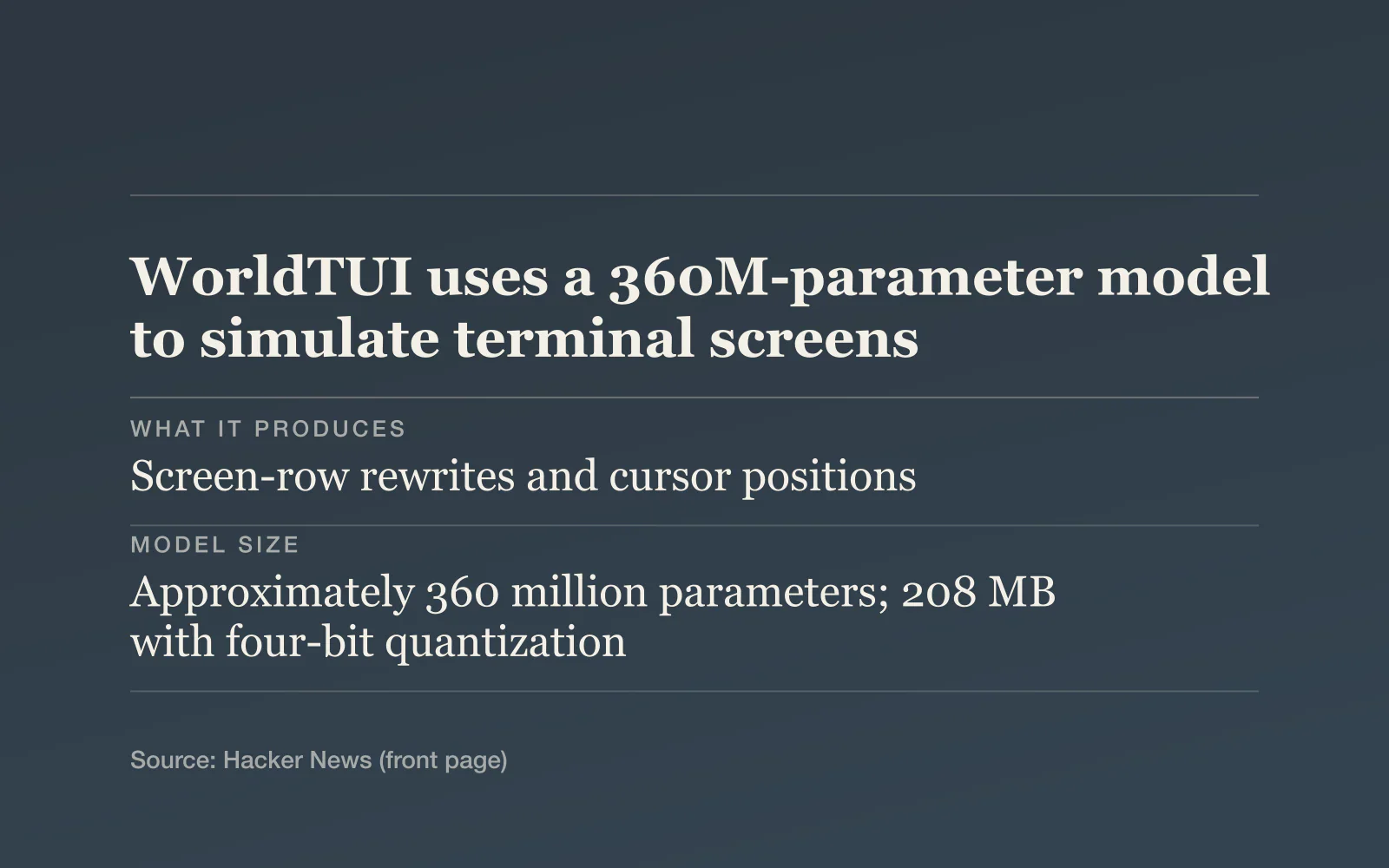
WorldTUI uses a 360M-parameter model to simulate terminal screens
The browser demo predicts screen changes from keystrokes. Its creator reports faster updates and improved simulated file recall, but filesystem consistency is unreliable.
By Benchdict AI DeskPublished Oct 22, 20264 min read

A browser demo called WorldTUI runs a roughly 360-million-parameter AI model locally to imitate a terminal, predicting screen changes from keystrokes with no shell or filesystem behind it.
Key facts
- What it produces
- Screen-row rewrites and cursor positions
- Model size
- Approximately 360 million parameters; 208 MB with four-bit quantization
- Intended setup
- Desktop browser with WebGPU and a physical keyboard; author recommends Chrome or Edge
- Reported command score
- 80 correct commands out of 106 on the author's ShellBench test
What happens when you type
AI/TLDR's October 21 entry identifies WorldTUI as Simon Edwardsson's project. The model generates replacements for screen rows and moves the cursor.
Edwardsson's account, also summarized by daily.dev, describes a simulation with no underlying command shell—the program that interprets commands—and no backing filesystem. File operations shown on screen are predicted output, not evidence that anything was written. Unlike an agent sending commands to a real shell, the model produces the apparent result itself.
From recorded sessions to faster updates
According to Edwardsson, WorldTUI was fine-tuned from Qwen2.5-Coder-0.5B, a code-oriented language model, using sessions recorded from real programs in Docker, a system for running isolated software containers. Vocabulary trimming reduced the parameter count from 494 million to approximately 360 million. Four-bit quantization, which stores model values at reduced precision, brought its size to 208 MB.
The author's training approach restricts predictions to valid screen-update structures and teaches recovery from the model's own errors. Correction training together with additional data raised PresetBench, a custom test suite, from 24 passed cases out of 47 to 38 out of 47 with the four-bit model. That comparison cannot isolate correction training's contribution.
In Edwardsson's latency comparison, the baseline is his earlier sequential method; the parallel method uses the same model to draft rows simultaneously and then check them sequentially. Large-frame p95 latency—the time within which 95% of updates finish—on an RTX 4090 graphics processor fell from 6.7 seconds to 0.87 seconds. A browser test displaying a manual page on his M4 Mac fell from 2.5 seconds to 0.9 seconds.
File recall remains a boundary
AI/TLDR reports 80 correct commands out of 106 on ShellBench, the author's command test. Edwardsson says both ShellBench and PresetBench were excluded from training.
The author's file-recall comparison reports nine correct readbacks out of 13, meaning displays of a file's contents after it was previously written in the simulation. The baseline score is unavailable, and the relationship to a separate 64-readback test is unexplained. Filesystem consistency remains unreliable when familiar commands appear in unfamiliar combinations.
In an earlier model checkpoint, Edwardsson reports that removing layer 7 without retraining largely preserved next-token accuracy—the ability to predict the next piece of output—but took exact memory readbacks from 64/64 to 0/64. For researchers evaluating model pruning, that experiment pairs a largely preserved prediction metric with a collapse in recall.
For desktop demo users, the author specifies a physical keyboard and a browser supporting WebGPU, the interface used to run computation on the graphics processor. Inference runs locally; Chrome and Edge are the recommended browsers.
Not yet confirmed
- The exact original publication date and public demo launch date are unconfirmed.
- The benchmark and latency results have not been independently reproduced in the cited coverage. ShellBench's scoring criteria, including what counts as a 'correct command,' are not described.
- AI/TLDR says the model weights are not public yet; first-party confirmation of that status, repository access and licensing remain unconfirmed.
- Minimum browser versions, GPU and memory requirements, maximum session length and detailed Python failure boundaries are unspecified.
- Local inference does not establish telemetry practices, other network activity or persistence across reloads.
What to watch
- Independent evaluations of file-state consistency across unfamiliar command combinations.
- Confirmed model-weight access and licensing terms.
- Published compatibility requirements and session limits.
Sources
- WorldTUI: I trained a 360M model to pretend to be a terminalHacker News (front page), Oct 22, 2026.
- WorldTUI — a 360M model that pretends to be a… | AI/TLDRAI/TLDR, Oct 21, 2026.
- WorldTUI: I trained a 360M model to pretend to be a terminal | daily.devdaily.dev, Oct 22, 2026.
Benchdict AI Desk, AI-assisted reporting desk. Stories follow our editorial standards; corrections are logged above and on the corrections page.