AMD and Intel plan shared oneDNN optimization path for PyTorch on CPUs
AMD will bring ZenDNN optimizations into oneDNN, aiming to simplify PyTorch deployment across both companies’ processors. Release targets remain unspecified.
By Benchdict Devices DeskPublished Oct 22, 20263 min read
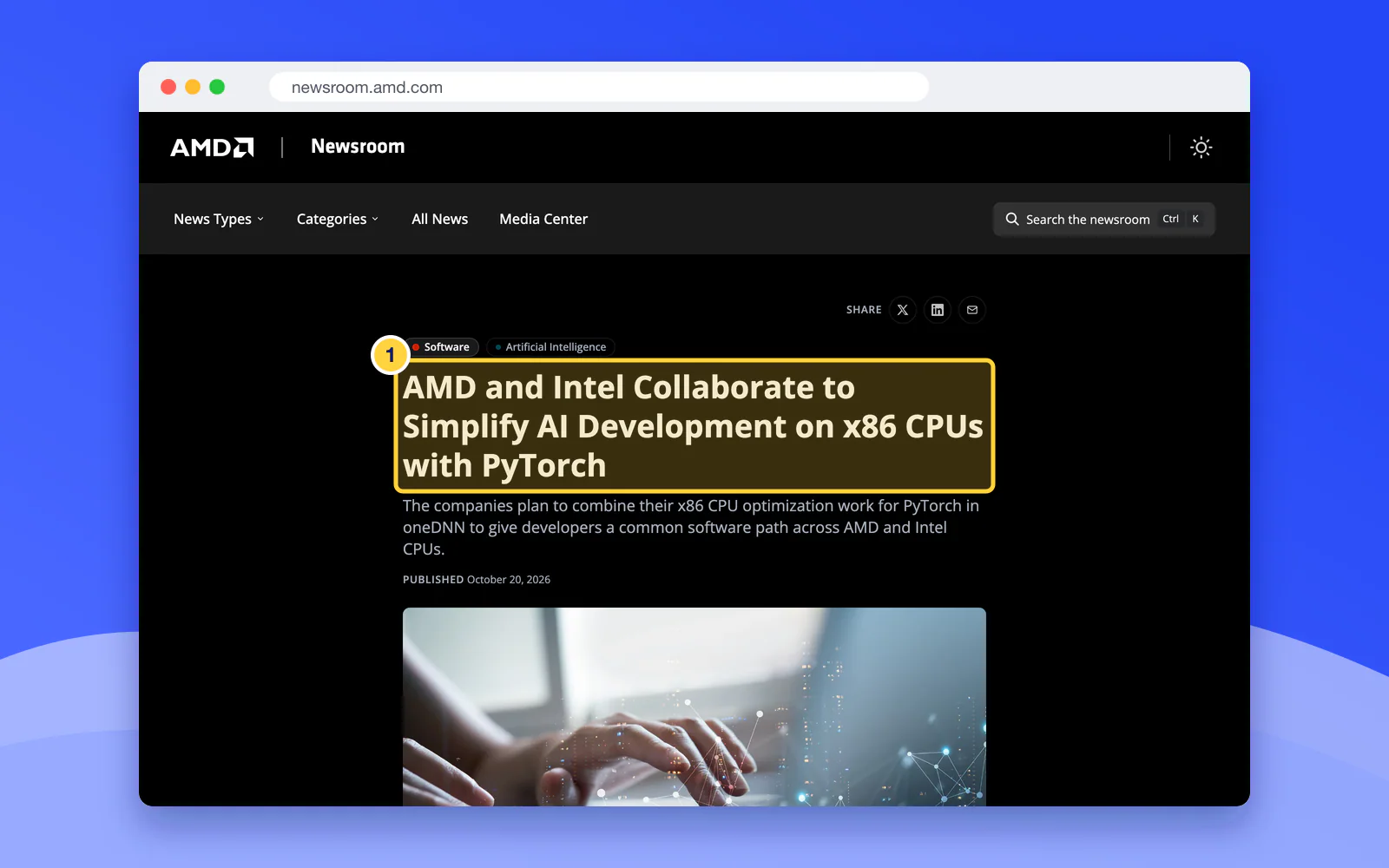
AMD says it and Intel have aligned on oneDNN, an open-source acceleration library, for PyTorch, an AI software framework. The collaboration announced October 20 would integrate optimizations from ZenDNN, AMD’s CPU inference library, into oneDNN.
Key facts
- Shared direction
- AMD says it and Intel have aligned on oneDNN as the default library for x86 acceleration within PyTorch
- AMD contribution
- Planned integration of ZenDNN optimizations, with continued AMD-specific tuning
- Governance
- AMD joins the Unified Acceleration Foundation as a steering member
- Availability
- No target PyTorch or oneDNN release specified
Where the optimization work will go
AMD’s announcement says the companies have aligned on oneDNN as the default open-source library for accelerating PyTorch on x86, the processor architecture used by their CPUs. AMD will contribute optimizations from ZenDNN, its library for inference—the execution of trained AI models—while continuing to tune software for its own processors.
Data Phoenix reports the planned integration and the companies’ goal of simplifying application development, maintenance and deployment. The intended change is a common destination for optimization work that has been maintained separately, giving developers deploying across both vendors a shared library path.
The agreement follows a recommendation from the x86 Ecosystem Advisory Group, according to AMD. CloudNews.Tech describes it as a group AMD and Intel created in 2024.
Mixed-vendor deployments are the intended beneficiaries
For teams maintaining PyTorch applications across AMD and Intel CPUs, Data Phoenix identifies the intended benefit as avoiding separate vendor optimization paths. Simpler development, maintenance and deployment are the collaboration’s stated goals.
For existing ZenDNN users, AMD’s repository still directs PyTorch users to zentorch, its integration plugin, for compatibility and installation details. That remains the documented route.
Not yet confirmed
- No integration timetable, target PyTorch or oneDNN versions, or released build containing the completed common path has been identified.
- The scope of ZenDNN components to be integrated, whether zentorch stays separate and whether ZenDNN continues as a standalone project remain unconfirmed.
- The announcement provides no measured inference speedups or demonstrated maintenance and deployment savings from this collaboration.
What to watch
- PyTorch and oneDNN release notes identifying the first integrated AMD optimizations.
- ZenDNN and zentorch documentation clarifying compatibility and the plugin’s future.
- Performance results for the integrated path across AMD and Intel processors.
Sources
- Simplifying AI Development on x86 CPUs with PyTorchAMD Newsroom, Oct 20, 2026.
- AMD and Intel bring PyTorch CPU work into oneDNN — Data PhoenixData Phoenix, Oct 20, 2026.
- GitHub - amd/ZenDNNGitHub, Oct 22, 2026.
- AMD Folds ZenDNN Into oneDNN, Giving PyTorch One x86 CPU Path Instead of Two - Hardware BustersHardware Busters, Oct 20, 2026.
- AMD and Intel Unify PyTorch Acceleration on x86CloudNews.Tech, Oct 21, 2026.
Benchdict Devices Desk, AI-assisted reporting desk. Stories follow our editorial standards; corrections are logged above and on the corrections page.