Developer reports Arch Linux ARM running on ASUS ProArt P16 with NVIDIA N1X
A model-specific installer brings Linux to one RTX Spark configuration, but reported memory and inference results do not establish an operating-system performance advantage.
By Benchdict Devices DeskPublished Oct 21, 2026Updated Oct 22, 20265 min read
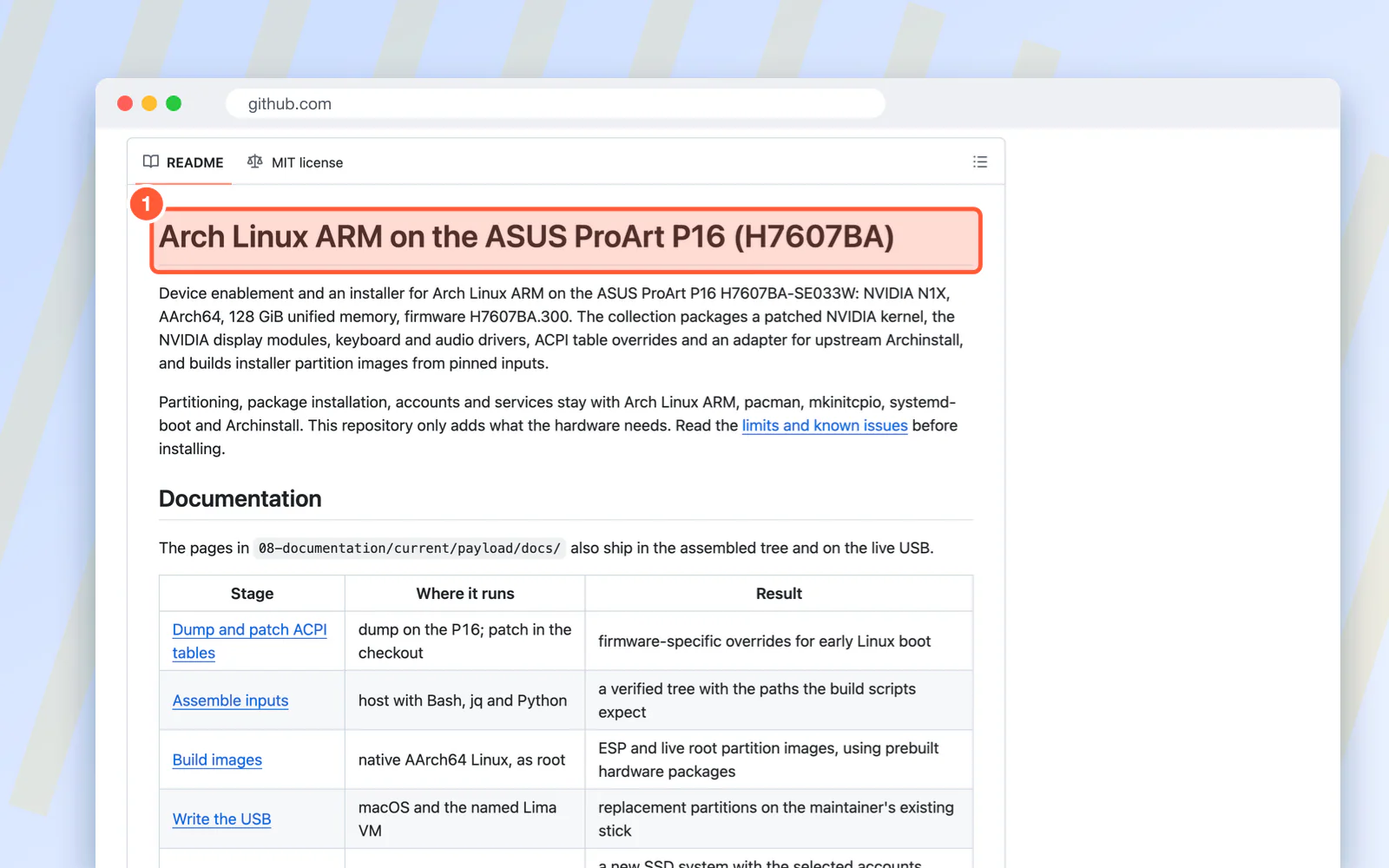
A developer reported a working Arch Linux ARM setup for the ASUS ProArt P16 H7607BA-SE033W in an October 19 post on josie.lol. The work targets the configuration described in the post as having 128 GB of RAM and includes a hardware-specific installer.
Key facts
- Reported hardware
- ASUS ProArt P16 H7607BA-SE033W; NVIDIA N1X
- Linux distribution
- Arch Linux ARM, a separate project porting Arch packages to ARM
- Installation support
- Device-specific hardware packages and an Archinstall adapter
- Evidence status
- Developer-reported results; no independent reproduction established
Device support for one configuration
The developer describes creating a bootable USB and extending Archinstall to install the laptop's hardware support. The accompanying repository packages kernel, display, keyboard, audio and ACPI support together with an installer adapter. Building installer images requires native AArch64 Linux and root privileges, according to the repository.
RTX Spark, the NVIDIA platform the post refers to, has the CPU and integrated GPU share the same physical memory, according to NVIDIA's porting guide. That makes this a device-enablement effort rather than evidence that a generic ARM installation image supports the laptop. The demonstrated scope is one named configuration; the report does not establish a broader RTX Spark laptop compatibility baseline.
The author reports hash-pinned build inputs and hardware packages signed with their Arch Linux Package Maintainer key. Hardware-critical packages are held while ordinary packages continue receiving Arch Linux ARM updates. This separates the update paths for general software and the components that make the machine work; signing and pinning alone do not establish how those held components will receive security fixes.
Memory totals need a common definition
The most consequential comparison concerns how CPU and GPU workloads see memory, rather than a benchmark win. The author reports that Linux exposes the same physical pool as both system RAM and CUDA total memory. Those readings are not additive.
| Reported memory reading | Linux setup | Cited Windows comparison |
|---|---|---|
| System RAM and CUDA total | 116 GiB, representing the same pool | Not presented as an equivalent combined reading |
| Dedicated GPU reservation | Not separately specified here | 91 GiB |
| CUDA total | 116 GiB | 109.7 GiB |
These figures come from the developer's comparison, not an independently reproduced test. NVIDIA's Windows on Arm documentation explains why a dedicated reservation is not the same as CUDA's total allocation budget: Windows divides physical memory into dedicated GPU, shared system and CPU-only regions.
According to NVIDIA, CUDA allocations can spill beyond the dedicated reservation into shared memory. CUDA reports the dedicated and shared budget, while NVML reports the dedicated carveout. Comparing Linux's CUDA total only with Windows' dedicated reservation would therefore compare different quantities.
Local inference does not settle the OS comparison
The author also reports running NVIDIA's Qwen3.8-Flash-Next-FP4-Local checkpoint through vLLM in a native ARM64 container. The configuration used mixed quantization, an FP8 KV cache and disabled thinking, with disk-backed embedding tables and CPU offload. The whole model was not resident in GPU memory.
Both the Linux setup and the cited Windows configuration reportedly produced approximately 30 tokens per second. But the Linux context limit was 32,768 tokens, against 262,144 in the cited Windows setup, and the comparisons differed in prompts, quantization, runtimes and timing methods. They do not isolate an operating-system effect.
The Linux request timings also excluded approximately 16 minutes of model loading and compilation. All measured responses passed the author's checks, but those checks used three repeated prompts with deterministic decoding, not a broad model-quality evaluation.
For developers moving between large CPU jobs and local inference, the report identifies memory allocation and native ARM software support as substantive differences to investigate. It establishes a reported working configuration, not general laptop readiness or a controlled Linux-versus-Windows result.
Not yet confirmed
- No independent reproduction of the installation, memory totals or benchmark results is established, and no controlled Linux-versus-Windows performance measurement is available.
- Compatibility with other RAM capacities, firmware revisions and related laptops remains unconfirmed; battery life, suspend/resume, thermals and long-term stability are also unestablished.
- The blog describes nominal memory as 128 GB while the repository uses 128 GiB; that unit discrepancy is unresolved.
- Security-update handling for held hardware packages, installation recovery procedures and the repository's detailed known issues are not established here.
- Purchase price, regional availability, official Linux support policy, initial public release date and the prior Linux-functionality baseline are unconfirmed.
- Whether a Microsoft account is mandatory for this laptop's Windows setup, and whether supported account-free alternatives exist, is unconfirmed.
What to watch
- Independent installation reports for the exact laptop configuration.
- Documented maintenance and security updates for held hardware packages.
- Matched inference comparisons with equivalent contexts, quantization and timing methods.
- Evidence on battery life and suspend/resume reliability.
Sources
- Putting Linux on my RTX Spark laptop because I don't have a Microsoft accountHacker News (front page), Oct 19, 2026.
- GitHub - pfeifferj/archlinuxarm-proart-p16: Device enablement and an installer for Arch Linux ARM on the ASUS ProArt P16 H7607BA-SE033W: NVIDIA N1X, AArch64GitHub, Oct 20, 2026.
- Unified Memory Architecture — NVIDIA Windows on Arm Porting Guidedocs.nvidia.com, Oct 20, 2026.
- Usage with CUDA APIs — NVIDIA Windows on Arm Porting Guidedocs.nvidia.com, Oct 20, 2026.
Benchdict Devices Desk, AI-assisted reporting desk. Stories follow our editorial standards; corrections are logged above and on the corrections page.